

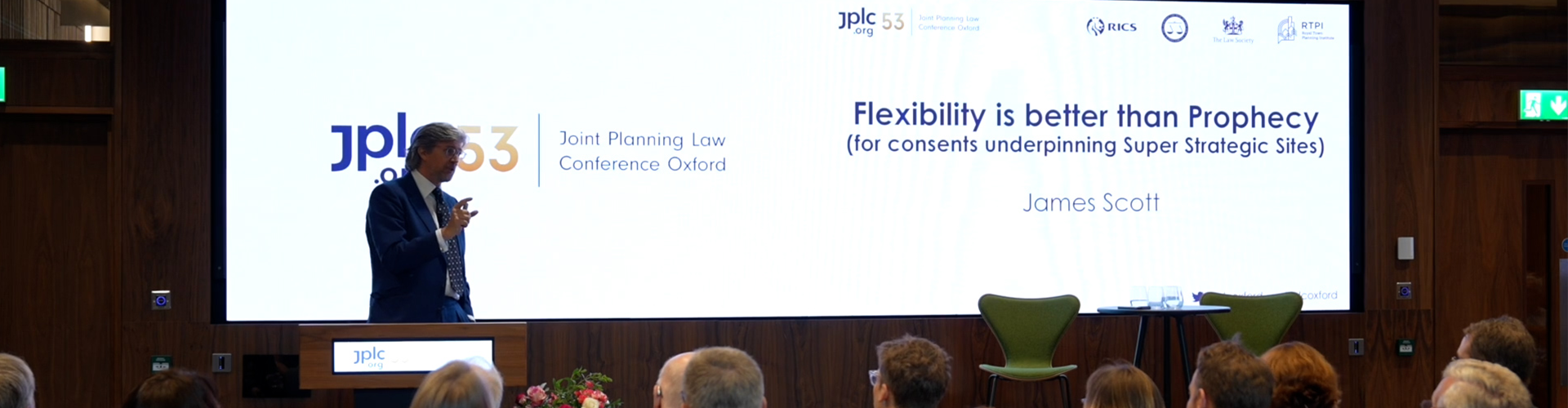
In September 2025, our Group Director of Strategy and Planning, James Scott, delivered a paper to the 53rd Joint Planning Law Conference (jplc.org) entitled Flexibility is better than Prophecy (for consents underpinning Super Strategic Sites). The paper and the appendices are set out below.
In December 2025, MHCLG published a draft NPPF for consultation. At policy HO13 it recognised the need for flexibility for “large scale residential and mixed use development which will be implemented through multiple phases across development plan periods”, and asked whether a “super strategic” site designation was needed (Questions 80, 81 and 82). Urban&Civic responded in March 2026, making the case for a codified designation and for the flexibility that such sites require.
On 17 August 2026, MHCLG published the new NPPF. Whilst not going as far as calling them Super Strategic Sites, it introduced Strategic Site as defined term into the Glossary at Annex B:
Strategic site: A site for residential, commercial or mixed-use development which would be implemented in multiple phases, have significant infrastructure requirements and require a masterplan. Typically, for a residential-led development, strategic sites would have capacity for at least 1,500 dwellings (although the scale of residential development can vary depending on the mix of uses on the site).
That term now runs consistently through the Framework, and policy HO13 is retitled “Build out of residential and strategic sites”. Policy HO13(3) sets out what it means for the consenting framework. In relation to development proposals for strategic sites, it should:
a. Set out the parameters and requirements for the design, infrastructure and other features of the development (including the quantity and type of affordable housing to be provided), with the level of initial and subsequent detail tailored to the proposed scale and phasing of the development; and
b. Be flexible enough to respond positively to changing circumstances as phases are brought forward, including changes to housing need, infrastructure requirements, viability and design.
Both Strategic Sites and the necessary flexibility to make them happen are now enshrined in national policy. The paper and appendices below set remain a helpful example of what it looks like in practice."
The Paper
This material was first published by Thomson Reuters, trading as Sweet & Maxwell, 5 Canada Square, Canary Wharf, London, E14 5AQ, in the Journal of Planning Law [2025] J .P.L. Issue 13 and is reproduced here by agreement with the publishers. For further details, please see the publishers' website here
The Presentation
The presentation that James made to the JPLC53 can be accessed below:
The Appendices
The paper has a number of appendices which illustrate the points made with further information and practical examples based on our site at Waterbeach in Cambridgeshire: