Climate Related Financial Disclosures
Urban&Civic recognises the significant implications of climate change and the transition to a low carbon economy on its operations and long-term value creation. Urban&Civic acknowledges both the risks and opportunities associated with this transition and is committed to integrating climate considerations across its business.
We have set out here our response under each of the four pillars of the Task Force on Climate-related Financial Disclosures (TCFD) framework: Governance, Strategy, Risk Management, and Metrics and Targets.
As per our 2024 Annual Report disclosure, we continue to comply with all but two of the disclosure requirements of the TCFD framework. The first area is ‘impact on organisation and financial planning’ where we have yet to quantify the potential financial impacts of climate change. The second area is ‘climate-related metrics’ because we haven’t implemented an internal carbon price into business decision making. We have not addressed these two areas yet because we are waiting for further details of the proposed UK Sustainability Reporting Standards to inform how we evolve our climate-related financial disclosures in the future.
Key TCFD related activities in 2025
Governance
- Two Sustainability and Health & Safety Committee meetings including a review of business performance and development of the new sustainability metrics.
- Approving the updated Sustainability Policy to include the acquisition of Todd’s Nursery.
- Four meetings of the Sustainability Champions Group to review ongoing development of new sustainability metrics for 2026-30.
- Revised sustainability reporting templates for quarterly Strategic Development Committees emphasising carbon reduction initiatives and potential risks.
Strategy
- Update to the U&C Map to Net Zero setting revised carbon reduction budgets and targets for the business and Strategic Sites. The Map to Net Zero was also updated to align with the carbon targets set by the UK Net Zero Carbon Buildings Standard and the latest grid decarbonisation scenarios.
- Development of a Carbon Forecasting Tool to adjust site carbon budgets as development plans evolve which in turn allows for more accurate progress reporting.
Risk
- Progress against managing physical and transitional risks and opportunities reviewed and updated
- Quarterly review of the relevant carbon and climate risks on the risk register and corresponding actions to maintain respective risk appetite
- A review undertaken of the potential business impacts and dependencies on nature and how this interrelates with climate risk
Metrics and targets
- Reporting performance against our current carbon and resilience sustainability metrics
- The development of new 2026-30 sustainability metrics which include specific carbon and climate targets covering:
- reduction targets for carbon emissions (Scopes 1, 2 and 3);
- climate resilience design recommendations in key phase design codes;
- increasing tree canopy cover across sites; and
- reduction in potable water consumption in the delivery and maintenance of landscaping
Governance
a) Board oversight of climate-related risks and opportunities
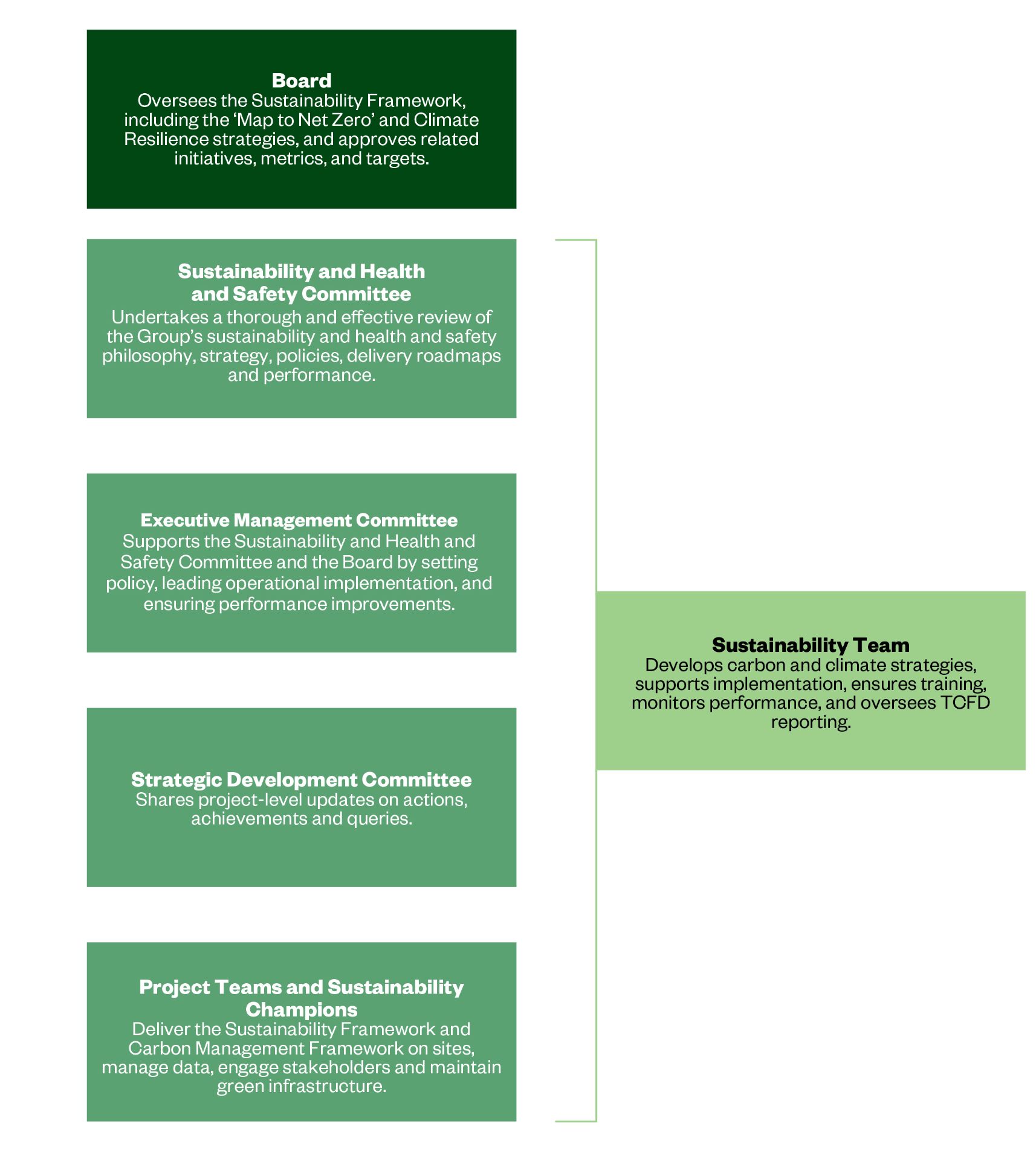
Urban&Civic recognises the material impacts that climate-related risks and opportunities have on business operations, and stakeholder value. The Board and the Executive Management Committee (EMC) provide the strategic vision that integrates climate resilience and carbon reduction within Urban&Civic’s Sustainability Framework. This framework is aligned with the company’s overarching Sustainability Policy and Net Zero ambitions, and is embedded across all project phases, supply chains, and governance structures.
The Board:
- Holds accountability for the Sustainability Framework, which includes defined action areas, key objectives, metrics, and climate related targets.
- Approves the corporate sustainability approach and reviews quarterly updates on climate-related targets, metrics, and strategies.
- Has set ambitious Net Zero goals.
- Established a Sustainability and Health & Safety Committee to oversee the delivery of climate strategies, plans, and performance monitoring. The committee meets twice in the year.
The Board’s oversight extends to approving business plans that incorporate climate resilience and adaptation measures within construction budgets and design strategies, ensuring climate risks are embedded in the annual business planning for each site.
b) Management’s role in managing climate‑related risks and opportunities
The Chief Executive Officer (CEO) holds overall responsibility for effective sustainability management across Urban&Civic and delegates day-to-day responsibility through the Managing Director and the Executive Management Committee to project delivery teams supported by the Head of Sustainability.
Key management roles include:
• Implementing and promoting policies that advance Urban&Civic’s sustainability objectives.
• Leading by example and fostering a business culture that prioritises carbon reduction and climate resilience.
• Assessing significant risks to sustainability objectives and implementing actions to mitigate identified risks.
• Supporting ongoing learning and capacity building across the business to advance climate awareness and behaviour change.
The Sustainability Champion Group continues to encourage employees to engage with our Sustainability Metrics and commitments on climate change, nature and health and wellbeing. This has been achieved through the sharing of ideas and bringing together a network of employees from various functions and locations of the business to discuss key learnings.
The Sustainability Team leads the implementation of the Map to Net Zero and climate change strategies, ensuring performance is monitored and aligned with evolving regulatory, stakeholder, and investor expectations.
Urban&Civic has defined roles and responsibilities for each level of governance within defined action areas.
The Urban&Civic reporting structure is set out as follows:
Strategy
a) Climate-related risks and opportunities
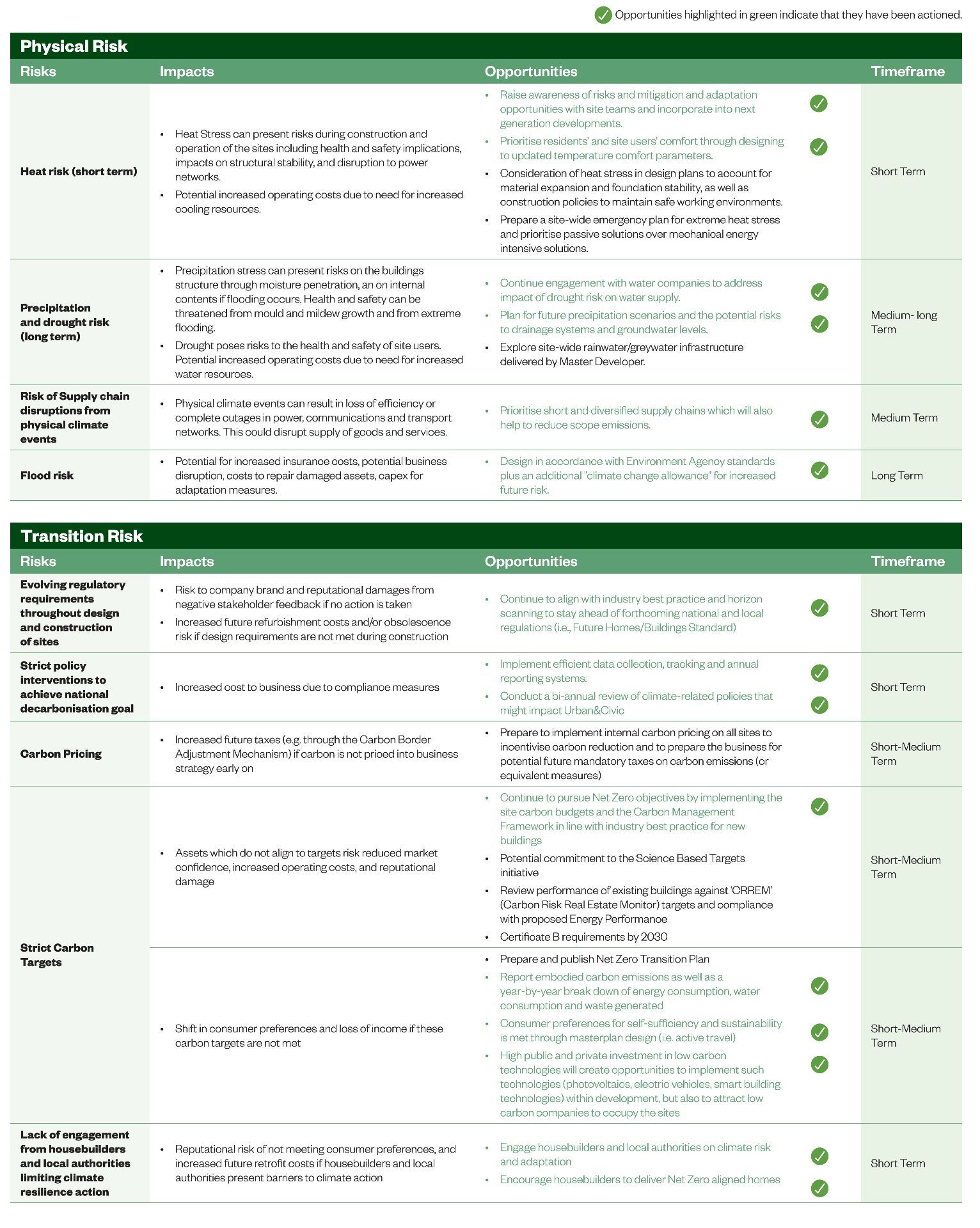
Urban&Civic integrates climate-related risks and opportunities into its business strategy and financial planning, considering the impacts of climate change across short (<5 years), medium (5-20 years), and long-term (>20 years) horizons. Scenario analysis aligned with 1.5°C, 2°C, and 4°C pathways has informed the resilience of masterplans, design, and delivery strategies across a number of sites.
Urban&Civic’s assessment of material climate risks was undertaken by way of the development of a climate resilience strategy prepared in 2023. The physical risks were assessed using Cervest Earthscan and included heat stress, drought
flood risks, and supply chain disruptions from physical climate events. This physical exposure was assessed across eight sites.
Transition risks included policy changes, carbon pricing, and evolving market expectations. Opportunities identified include low-carbon technology adoption, nature-based solutions, and the development of sustainable, active travel-oriented communities.
Climate-related transition risks include the transition towards a low carbon economy, across four key categories of policy and legislation, market, technology, and reputation.
b) Impact of climate-related risks and opportunities on business, strategy, and financial planning
Urban&Civic actively integrates the identified climate-related risks and opportunities into its business strategy and financial planning to ensure resilience across its portfolio. Climate related risks influence design standards, construction methods, delivery timelines, and operational practices, while opportunities drive innovation in low-carbon technologies,
renewable energy use, and the development of nature-based, resilient communities.
Physical risks such as heat stress, flooding, and drought are factored into construction budgets and design plans, ensuring long-term resilience of assets under future climate scenarios. Transition risks, including evolving policy requirements and carbon pricing, shape investment decisions, aligning projects with regulatory expectations and stakeholder demands.
Urban&Civic’s Map to Net Zero guide emissions reduction strategies across Scope 1, 2, and 3, influencing capital allocation to ensure alignment with Net Zero targets. The incorporation of climate-related considerations into site masterplans and project planning enables the business to capitalise on opportunities related to renewable energy, sustainable mobility, and
green infrastructure while safeguarding against climate risks.
Overall, the integration of climate risks and opportunities ensures that Urban&Civic’s developments are prepared for a low-carbon future, protecting asset value, enhancing stakeholder trust, and contributing to the resilience of communities in which it operates.
Prioritisation of risks
The Board’s Risk Matrix has been expanded to identify, quantify and monitor relevant risks. This is reviewed by the Sustainability and Health and Safety Committee in the first instance. Climate-related risks include net zero emissions targets, physical climate risks, meeting sustainability targets, and regulatory compliance.
Each risk is categorised by probability and four impact categories based on financial, performance, reputation and regulatory impact. Risks are scored on a scale from 1–5 depending on severity.
All risks considered to be material require mitigation. The Risk Matrix is reviewed every quarter with risks prioritised by impact following mitigation.
If there is a greater certainty of a risk being realised and the likely impact is significant, the risk will be added into the project and business cash flows. Alternatively, the risk might reduce in likelihood and/or severity and then eventually get
taken off the risk register.
c) Resilience of strategy considering climate scenario analysis
With increasing risks being realised from climate and nature related challenges, both mitigation and adaptation approaches are key when considering forward-looking investment. The pathway to enhance climate resilience comprises the following:
- Future-proofing sites to withstand the weather and social risks associated with climate change, by integrating appropriate strategies within landscaping and development masterplans.
- Optimising the health and wellbeing of people who use community buildings by carefully considering relevant environmental factors to ensure the provision of a comfortable indoor environment even as outdoor conditions are subject to fluctuation.
- Maximising asset resilience through effective management of all sources of flood risk within site boundaries and application of an additional climate change allowance to flood risk design; and
- Integrating the co-benefits from carbon emissions reduction (mitigation) and measures to reduce vulnerability to climate change (adaptation). Co-benefits might include cleaner air, enhanced transit, improved healthcare outcomes, better insulated and more efficient housing, and better climate literacy rates.
Risk Management
a) Processes for identifying and assessing climate-related risks
Urban&Civic has implemented structured processes to identify and assess climate- related physical and transition risks across its strategic sites and operations. The tools and resources used throughout the carbon management process can be subdivided into strategic tools which provide carbon targets and guidance, data collection and reporting resources, and knowledge and sharing guidance to establish feedback and increase carbon literacy within Urban&Civic and the wider value chain partners.
Urban&Civic’s Sustainability Team and project teams collaborate to ensure climate risk assessments inform the development of climateresilient designs and Net Zero pathways, while site-specific risks are escalated through the Strategic Development Committees to the Executive Management Committee and the Board for review and mitigation planning.
This integrated risk assessment process ensures that climate-related risks are systematically
identified, prioritised, and managed in alignment with Urban&Civic’s commitment to climate resilience and sustainable development.
b) Processes for managing climate‑related risks
Urban&Civic manages climate-related risks by embedding assessment and mitigation into the master developer business model, reflecting its scalable approach across strategic sites. Physical climate risks such as flooding, heat stress, and drought are managed through the delivery of resilient green, grey and community infrastructure, nature-based solutions, and energy efficiency initiatives, ensuring climate adaptation is integrated at every stage of the development, from pre-development through to completion and disposal.
During master planning, due diligence assessments will consider a physical climate risk screening across climate scenarios, an assessment of local authorities’ climate regulations, and a climate opportunity assessment including assessment of renewable energy feasibility, carbon sequestration potential, and public transport accessibility. These initial assessments will form initial strategies, including the design carbon budget aligned to the 1.5oC reduction pathway.
Internal carbon modelling provides a high-level estimate of the baseline carbon footprint of the potential development site. To determine if the estimated carbon emissions of a potential site are high, they will be reviewed against the available carbon budget in the Map to Net Zero.
Prior to submission of the Outline Planning Application, more detailed risk assessments can be conducted that look into supply chain, macro environment, and site exposure, sensitivity and adaptive capacity, as well as the detailed physical and transition assessments.
Throughout the development process, there are six key stages where climate risk reduction and resilience strategies are implemented into the business strategy: strategy, brief, concept design, detailed design and procurement, construction,
and operation and maintenance.
In an effort to engage with external contractors to assess and encourage climate action and disclosure, Urban&Civic asks for information at pre-qualification questionnaire stage as evidence of procedures to monitor, manage and report on carbon emissions and climate risks within their organisations, and methods of external validation of sustainability credentials.
c) Integration into overall risk management
Urban&Civic delivers its strategic objectives through operating a Board led risk management framework that:
- Defines the nature and scale of risk that the Group is prepared to take (risk appetite);
- Identifies and assesses risks applicable to the Group’s strategy and operations (both existing and emerging);
- Controls risk through the design and implementation of mitigating actions, controls and procedures;
- Tests to seek assurance over the effectiveness of those mitigating actions, controls and procedures; and
- Reviews and refines the Group’s risks on an ongoing basis against risk appetite, acknowledging that risk cannot be fully eliminated.
Climate is one of the eleven identified risk areas for the business and therefore is integrated into our overall risk management processes as addressed above. Climate risk is currently assessed as a medium risk, which is above risk
appetite, due to increasing legislation and growing stakeholder sentiment.
The table below identifies the material climate-related physical and transition risks and opportunities for our sites and development activities.
Metrics and targets
a) Climate-related metrics used to assess climate-related risks and opportunities
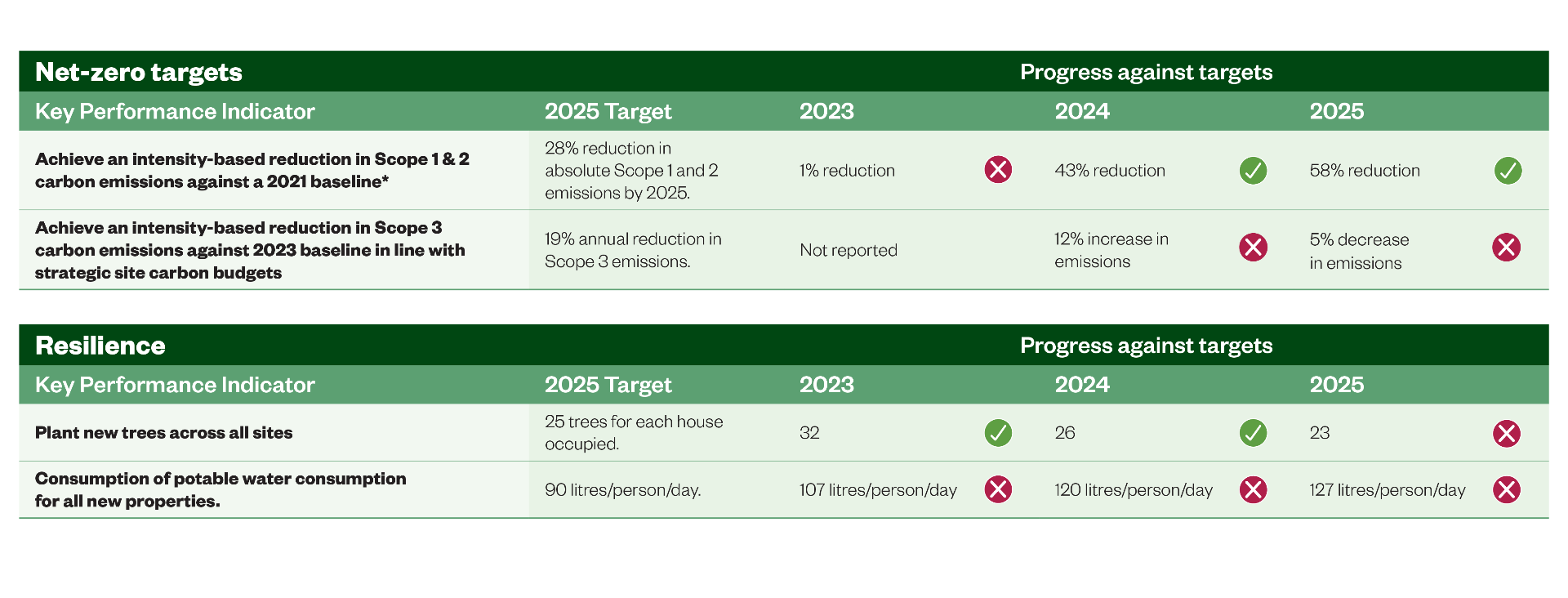
We have set a comprehensive range of sustainability targets and metrics that are detailed elsewhere in this report. These include several climate-related metrics and targets which are measured and reported in order to manage our climate-related risks and opportunities. Our 2025 metrics and targets and performance against them are shown in the table
below.
Our long term objective to meet Net Zero for Scope 1, 2 and 3 emissions remains a key metric to assess our climate-related risks and opportunities. Our Scope 1 and 2 Net Zero target remains at 2030 however this is conditional on how quickly the electricity grid decarbonises and therefore we are at risk of not meeting this target. We will continue to pursue our objective to achieve Net Zero for our Scope 3 emissions by 2040. Putting the business on a 2040 aligned trajectory is difficult because future grid decarbonisation and technological innovation is uncertain and unrealistic. We have therefore continued to set SBTi aligned targets out to 2035 for our strategic sites which were updated in our Map to Net Zero this year.
We have also set new climate-related metrics and targets for 2030 that support our ongoing assessment and management of climate-related risks and opportunities. Our new climate specific metrics are:
- Achieve an intensity-based 45% reduction in Scope 1 & 2 carbon emissions by 2030 against a 2025 baseline (75% reduction since 2021)
- Achieve an intensity-based reduction in Scope 3 carbon emissions (against a 2025 baseline in line with strategic site carbon budgets) comprising 33% reduction for upfront building and infrastructure emissions and 50% reduction for in-use building emissions by 2030
- All key phase design codes to include climate resilient design recommendations to mitigate and adapt to the future impacts of climate change
- 20% average tree canopy cover per key phase in design or delivery
- 20% reduction by 2030 in potable water consumption in the delivery and maintenance of landscaping projects across all strategic sites, either through switching to non-potable water supplies or implementation of efficiency initiatives measured against a 2025 baseline water footprint.
b) Scope 1,2 and 3 emissions and the related risks.
Our Scope 1, 2 and 3 carbon emissions are set out in the Annual Report 2025 which includes our Streamlined Energy and Carbon Reporting (SECR) disclosure.
c) Scope 1,2 and 3 emissions and the related risks climate-related targets to manage climate-related risks and opportunities and performance
Our 2025 climate-related targets and performance against them are shown in the table below.